
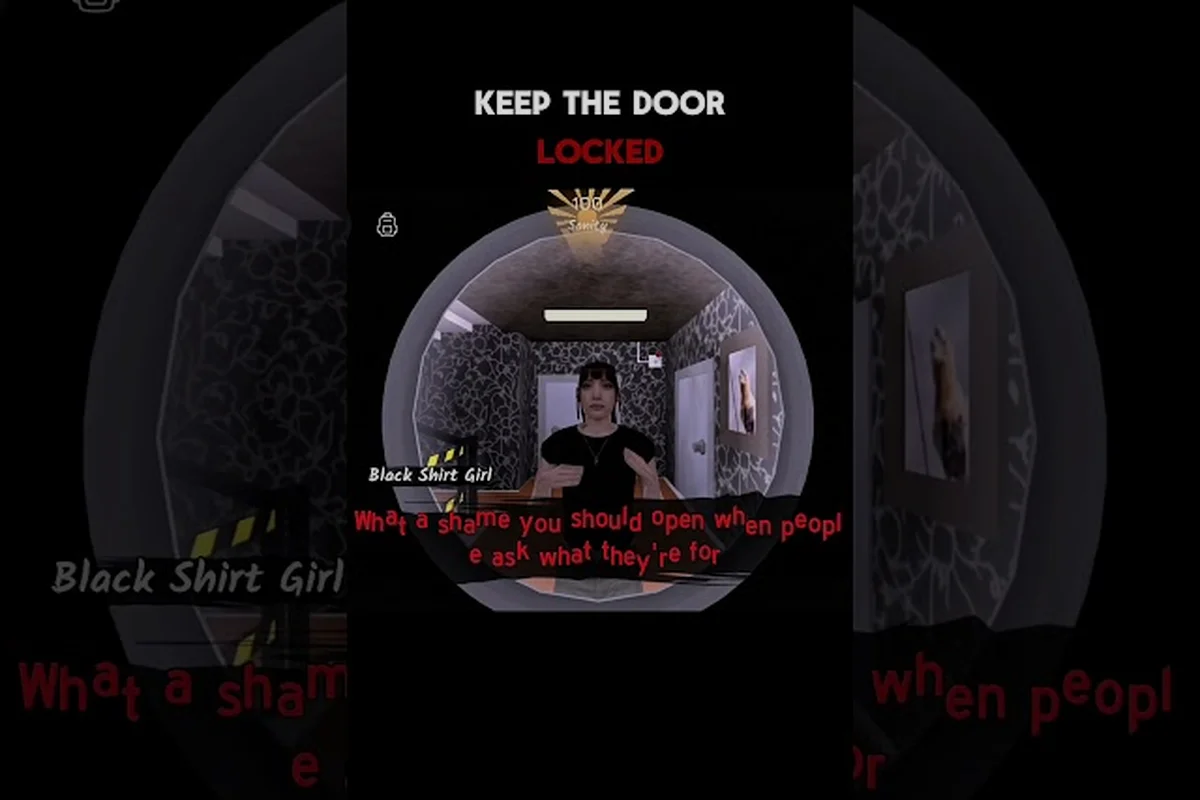
Every knock changes everything. Deciding who to let inside in Keep the Door Locked separates survivors from statistics, because one wrong choice can end the night instantly. This guide breaks down the visitor roster, the verification tricks that work, and the rules that keep you breathing until sunrise.
Since the game launched on May 28, 2026, over 4.3 million visits have poured into the hotel room service experience, with more than 10,000 players online at peak hours. The developer, Hotel Room Services (KivC), designed the game around a simple but brutal premise: strangers knock, some need help, and others are lying. Your ability to tell the difference determines everything, which is why knowing who to let inside matters before the first knock echoes through your room.
Visitor System Rules for Who Gets Inside
The visitor system operates on a pattern-based logic that rewards careful observation over blind trust. Every knock follows the same sequence: a voice announces their presence, the camera feed shows the hallway, and you decide whether to open the door or stay silent. The tension comes from the fact that the visitor roster includes police figures, neighbors, distress callers, night drifters, and repeat callers, each with their own tells.
Authority figures like police officers demand entry with urgency, but their stories often fall apart under scrutiny. Distress callers claim emergencies that rarely match what you see on the hallway camera. Neighbors seem harmless but can turn hostile when you least expect it. Night drifters wander the hallways with no clear purpose, and repeat callers test your patience by returning multiple times during the same shift.
The game tracks your decisions quietly in the background, and community reports suggest that your survival rate improves dramatically when you verify before opening. According to players who have logged dozens of nights, the core loop rewards a simple approach: check the camera, listen to the story, look for contradictions, and only then decide.
How the Knock Sequence Works
Every visitor follows the same three-phase sequence that gives you critical information before you commit to a decision: the approach, the pause, and the exit. During the pause, you can safely observe their pathing and timing, which is vital for timing your door locks. Many players use this window to bait them closer, but remember that a rushed lock can trap you in a corner.
-
The knock phase: The visitor announces themselves through the door, and the game gives you their stated reason for being there.
-
The camera phase: The hallway feed activates, letting you observe body language, uniforms, and any props the visitor carries.
-
The decision phase: You choose to open the door, ignore the knock, or in some cases, call for backup through the room phone.
The sequence repeats for every visitor, but the details change subtly each time, which means you cannot rely on memorized responses alone. The game intentionally mixes safe and dangerous patterns so that treating every visitor the same way leads to failure.
Why Verification Beats Instinct
Human instinct tells you to help someone in need, and the game exploits exactly that impulse. Community testing has shown that distress callers who claim emergencies are often lying, and the room behind them tells the real story. Players report that checking the room first through the peephole or the secondary camera angle reveals whether the claimed emergency actually exists.
The same logic applies to authority figures. A police officer who claims to be investigating a disturbance in your room becomes suspicious when no disturbance appears on any camera feed. The game rewards players who cross-reference every claim against observable evidence rather than trusting the words alone.
The Complete Visitor Roster: Who Knocks and What They Want
| Visitor Type | Typical Claim | Danger Level | Key Tell |
|---|---|---|---|
| Police Officer | Investigating a disturbance | High | Story rarely matches camera evidence |
| Neighbor | Borrowing something or checking in | Medium | Overly friendly, lingers after request |
| Distress Caller | Needs urgent help | High | Emergency often absent from room view |
| Night Drifter | No clear purpose | Medium | Wanders, repeats phrases, ignores questions |
| Repeat Caller | Returns with new story | High | Second story contradicts the first |
The danger levels reflect community consensus based on hundreds of documented encounters. Police officers and distress callers pose the highest risk because their stories pressure you into opening quickly, while night drifters and neighbors give you more time to assess the situation.
Authority Figure Patterns
Police officers arrive with a sense of urgency that makes them one of the most stressful visitors to handle. According to players who have tracked dozens of encounters, the officer's story must be verified against the room before opening, because the claimed disturbance frequently does not exist. When the officer mentions a break-in or a noise complaint, check the secondary camera angles for any sign of forced entry or unusual activity.
The critical mistake most players make is letting the urgency rush their decision. An officer who becomes impatient or repeats the same phrase without adding new details often signals danger. Community reports indicate that the safest approach involves waiting for the full story, verifying it against camera evidence, and then deciding based on observable facts rather than emotional pressure.
Distress Caller Red Flags
Distress callers activate the strongest emotional response because they claim to need immediate help. However, the game intentionally makes these claims unreliable. Players report that the hallway camera often shows a calm, empty corridor while the caller describes a medical emergency or an attacker nearby.
The verification trick that works consistently involves checking the room view before responding. If the hallway and room show no signs of the claimed emergency, the distress call is likely a trap. Safe distress scenarios, which appear less frequently according to community data, show visible evidence of the problem before you open the door.
How to Verify Visitors: Camera Tricks and Audio Cues
The verification process relies on three tools that the game gives you from the start: the hallway camera, the room peephole, and the audio feed. Each tool provides different information, and combining them gives you the clearest picture of whether the visitor is safe.
The hallway camera shows body language, uniforms, and props, letting you spot inconsistencies in a visitor's stance or gear before they reach the door. The peephole gives you a closer view of facial expressions and small details, which is crucial for catching nervous twitches or mismatched accessories. The audio feed lets you hear background sounds that might contradict the visitor's story, like distant footsteps or muffled voices that don't match their claimed location.
| Verification Tool | What It Reveals | Best Use Case |
|---|---|---|
| Hallway Camera | Body language, uniforms, props | First assessment of every visitor |
| Room Peephole | Facial details, eye movement | Checking for nervousness or aggression |
| Audio Feed | Background sounds, voice consistency | Verifying emergency claims |
Players who use all three tools consistently report higher survival rates, because each tool catches different types of deception. A visitor who looks calm on the hallway camera might show nervous eye movement through the peephole, and a distress caller whose story mentions an attacker might have a suspiciously quiet audio background.
Step-by-Step Verification for Letting Visitors In
The verification process that veteran players recommend follows a clear sequence that takes about thirty seconds per visitor: first, check the visitor's nameplate for any suspicious symbols, then observe their movement patterns near the door for a full ten seconds, and finally, listen for the telltale audio cue that signals a mimic. This routine minimizes risk during high-traffic waves, as experienced players know that rushing the check often leads to a fatal misidentification.
-
Step 1: Check the hallway camera as soon as the knock sounds, noting the visitor's appearance and any props they carry.
-
Step 2: Listen to the full story without interrupting, paying attention to specific details that can be checked later.
-
Step 3: Switch to the peephole view for a closer look at facial expressions and small details.
-
Step 4: Use the audio feed to listen for background sounds that confirm or contradict the story.
-
Step 5: Check the room and hallway for evidence of the claimed situation before deciding.
This process works because it forces you to slow down and gather evidence instead of reacting emotionally. Community data suggests that players who follow a consistent verification routine survive significantly more nights than those who decide based on first impressions.
Safe Visitors vs. Dangerous Visitors: The Decision Framework
The decision framework that most successful players use categorizes visitors into safe, cautious, and dangerous groups based on observable evidence rather than stated claims. This framework appears consistently across the visitor decision guide that players reference when discussing survival strategies.
Safe visitors typically show consistent stories, visible evidence for their claims, and calm body language. These visitors can be let inside with minimal risk, and they often reward you with items or information that helps later in the night. Checking their ID through the peephole and listening for hesitation in their voice are key tells, as even a brief pause can signal a trap.
Cautious visitors require extra verification because their stories check out partially but leave room for doubt. Community experience suggests that letting cautious visitors inside sometimes works, but the risk-reward balance favors extra verification before committing. In practice, this means checking their ID twice and watching for any hesitation in dialogue, as a single missed clue can turn a quiet night into a sudden chase sequence.
Dangerous visitors show clear red flags: contradictory stories, missing evidence, aggressive body language, or repeated phrases that suggest a scripted deception. These visitors should never be let inside, and ignoring them entirely is often the safest option. In practice, even a single missed cue can trigger a sudden attack, so players should watch for pauses between lines—a tell that the AI is cycling through its scripted responses.
The Quick-Judgment Table
For players who want a fast reference during tense moments, the following table summarizes the decision framework based on community documentation. It condenses the core choices—whether to hide, barricade, or flee—into a single glance, helping you react before the monster’s footsteps grow louder. Veterans often keep this table open on a second monitor, since hesitation in the hallway can mean instant death.
| Evidence Observed | Likely Category | Recommended Action |
|---|---|---|
| Story matches camera evidence | Safe | Open the door |
| Story partially checks out | Cautious | Verify further before opening |
| Story contradicts camera evidence | Dangerous | Do not open |
| No clear purpose or wandering | Cautious | Observe longer before deciding |
| Repeated phrases with no new info | Dangerous | Do not open, ignore knock |
The key insight from this framework is that evidence consistency matters more than the visitor type. A police officer whose story checks out is safer than a neighbor whose story falls apart, despite the officer carrying more authority. In practice, players should prioritize cross-checking every detail against the house's clues, since even minor contradictions can escalate a situation, while a fully coherent narrative often signals a safe encounter regardless of the visitor's uniform.
What Happens When You Make the Wrong Choice
The consequences of letting the wrong visitor inside range from minor setbacks to instant failure, depending on the visitor and the night's difficulty level. According to player reports, dangerous visitors who gain entry can attack immediately, drain your health, or trigger a chase sequence that requires quick reflexes to escape.
Community data indicates that the game punishes mistakes consistently but not always instantly. Some dangerous visitors give you a brief window to react after entering, while others attack without warning. This unpredictability makes prevention the only reliable strategy, which is why the visitor list reference remains one of the most consulted resources in the player community.
Advanced Strategies for Surviving Multiple Visitors
As the night progresses, the game sends multiple visitors in sequence, and the difficulty ramps up as the hour grows later. Advanced strategies focus on managing resources, tracking patterns, and adapting to changing circumstances, since each new visitor type demands a different response—like saving flashlight batteries for the faster stalkers or memorizing the order of door knocks to avoid wasting repairs. Players often note that the final hour’s unpredictability is where most runs fail.
The room phone becomes your best friend during multi-visitor nights, because it lets you call for assistance or request backup in certain situations. Community reports suggest that backup calls work reliably for authority-safety scenarios but fail during distress scenarios, which adds another layer of decision-making.
Tracking Visitor Patterns Across the Night
Players who survive consistently maintain a mental log of every visitor they encounter, because the game references earlier interactions later in the night. A repeat caller who returns with a new story becomes far easier to judge when you remember the original story and can spot the contradictions.
The tracking strategy that works best involves noting three things about every visitor: their stated claim, the evidence you observed, and whether the interaction ended safely. This log gives you the context needed to judge repeat visitors quickly and confidently.
For players who want a deeper breakdown of unusual encounters, the strangers at door guide covers edge cases and rare visitor behaviors that deviate from standard patterns. This includes timing quirks, such as visitors arriving during power outages or when the door is partially repaired, which can alter their knock sequences. The guide also highlights community-tested strategies for identifying disguised visitors, ensuring you don’t waste precious lock durability on false alarms.
Managing Multiple Knocks in Quick Succession
Some nights feature rapid-fire knocking where multiple visitors arrive within seconds of each other. This pressure test forces you to prioritize verification speed without sacrificing accuracy, and the game punishes both hesitation and recklessness. On these chaotic rounds, checking the door camera in quick bursts becomes essential, as even a single misidentified knock can trigger a fatal jump-scare. Experienced players often pre-position near the door to shave off precious reaction time, knowing that a steady rhythm of peeks and locks beats frantic guessing.
The technique that veteran players recommend involves pre-checking the hallway between visitors so that the moment a new knock sounds, you already have partial information. This preparation reduces the verification time for each subsequent visitor and keeps your decision quality high.
Practical Tips for New Players Learning Who to Let Inside
Starting out in Keep the Door Locked means accepting that you will make mistakes, but the right preparation reduces those mistakes significantly. The following tips come from community experience and apply to players at every skill level. For instance, learning to time door repairs between monster patrols—rather than reacting late—can save you from a fatal corner, and veterans often recommend keeping a flashlight on your hotbar to spot shadow movement early.
-
Never open immediately: The first ten seconds after a knock contain critical information, and opening early skips that intel entirely.
-
Check the room before trusting emergency claims: The hallway camera shows what the room looks like, and emergency claims that do not match the room view are traps.
-
Trust evidence over authority: A uniform does not guarantee safety, and a police officer's story can be as false as any other visitor's claim.
-
Keep a visitor log: Tracking your encounters helps you judge repeat callers and spot patterns that the game expects you to notice.
-
Watch for repeated phrases: Dangerous visitors often repeat themselves because their dialogue is scripted, while safe visitors add new details as they speak.
The Survival Mindset
The players who survive the most nights treat every knock as a puzzle rather than a threat. This mindset shifts the experience from fear-driven reaction to evidence-driven decision-making, which consistently produces better outcomes according to community statistics. By tracking knock patterns and timing responses, veterans avoid wasting limited repairs, turning each night into a calculated risk assessment that newcomers often overlook.
The guest list reference that players maintain includes notes on safe patterns, dangerous tells, and the latest community discoveries about visitor behavior. Staying current with this information helps you adapt to any changes the developer introduces, such as a visitor’s altered speed or new door-knock sequences. Reviewing it before each run lets you prioritize which rooms to barricade first, reducing wasted resources and surprise deaths.
When to Trust Your Instincts
Despite the emphasis on verification, instinct still plays a role in the game. Players report that a feeling of unease often precedes dangerous encounters, and trusting that instinct when evidence is ambiguous has saved many nights. This is especially true when audio cues are faint or doors remain slightly ajar, prompting seasoned players to retreat or lock down early rather than risk a fatal misstep.
The balance between verification and instinct comes down to experience. New players should lean heavily on verification because their instinct lacks data to work with, while veteran players can trust their gut faster because they have internalized the patterns through dozens of nights.
Frequently Asked Questions
What happens if I let a dangerous visitor inside?
Dangerous visitors can attack immediately, drain your health, or trigger a chase sequence that requires quick escape. The exact consequence depends on the visitor type and your current health, but the outcome is never positive, which is why prevention is the only reliable strategy.
How do I identify a police officer who is actually dangerous?
Verify the officer's story against camera evidence before opening. A genuine officer's claim typically matches observable details, while a dangerous officer's story falls apart because the claimed disturbance does not appear on any feed. This cross-check is your only reliable safeguard against impersonation.
Do repeat callers ever become safe?
Repeat callers are never safe, regardless of how many times they appear. Community data shows their danger increases when their second story contradicts the first, making them deliberate tests of your pattern recognition. The safest approach is to ignore them entirely, as no scenario rewards trusting a repeat caller.
Should I use the room phone for backup during visitor encounters?
The room phone works reliably for authority-safety scenarios but often fails during distress scenarios. Community reports suggest that backup calls during distress situations either arrive too late or trigger additional complications, so reserve the phone for cases where you have strong evidence of genuine danger.
How many visitors can appear in a single night?
Visitor count varies by night and difficulty, ranging from two to eight per night. Later nights bring more visitors and greater pressure, so early nights are best for practicing your verification routine. This balance between empathy and survival defines each night in the hotel room.